
3 Megatrends to Watch at CES 2026
AI has moved from experimental to essential, according to CTA’s Brian Comiskey
As part of his annual “CES 2026 Trends to Watch” presentation ahead of the biggest tech conference of the year, Futurist and CTA Senior Director of Innovation & Trends Brian Comiskey gave attendees a big-picture look at what to expect at this year’s show.
Because CES is a celebration of innovation, attendees shouldn’t expect much by way of doomsaying or even handwringing. The focus of the show is the future and how tech can potentially solve problems, not necessarily on ethical implications or what problems a headlong rush into new technology might cause.
Take artificial intelligence, for example. In a few short years — and despite concerns about its impact on everything from the job market to the environment — AI has moved from the stuff of science fiction to daily reality for most people.
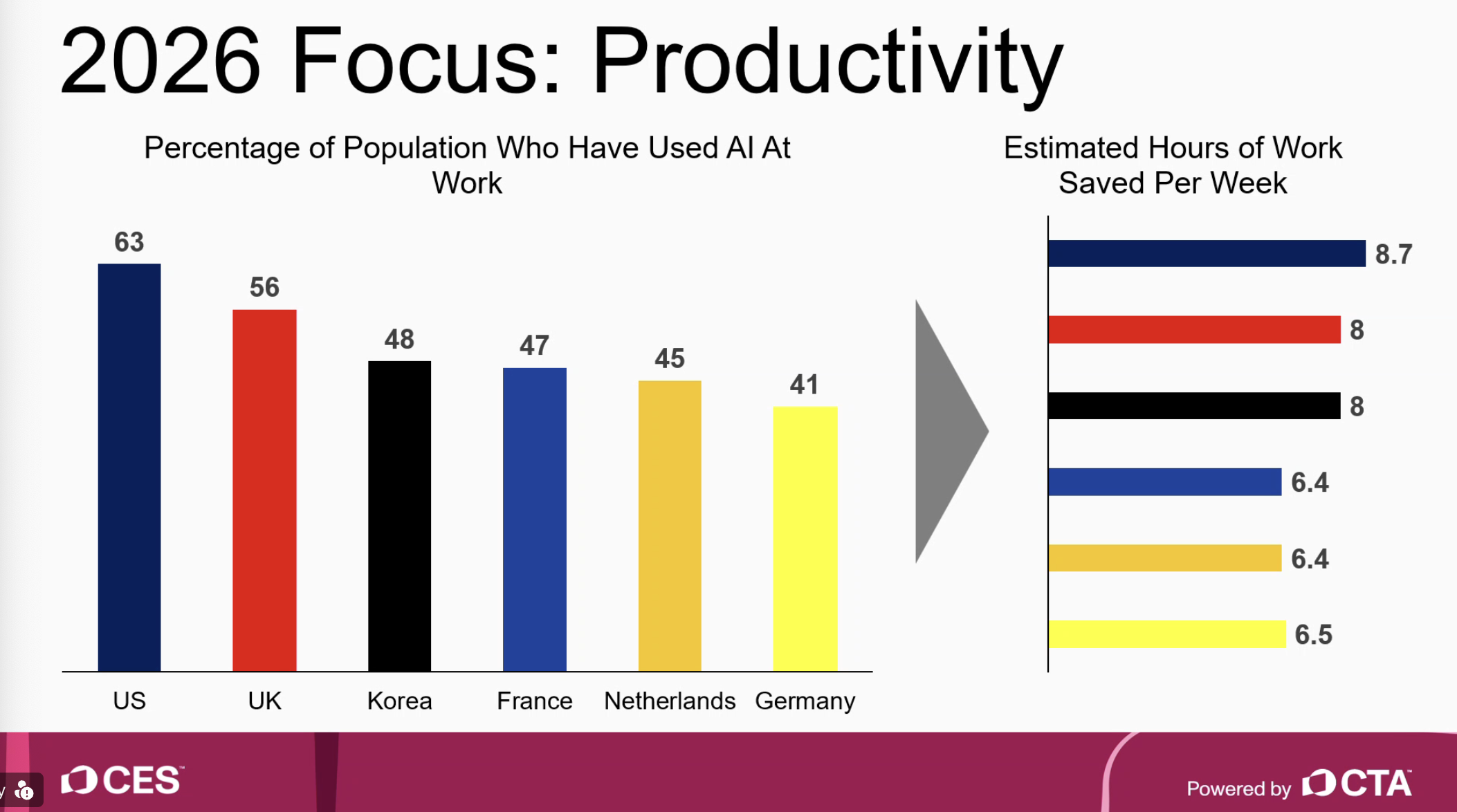
According to CTA research, 63% of people in the U.S. report using AI at work. For the U.K., that number is 56%. South Korea is 48%; France is 47%: Netherlands is 45%; and Germany is 41%. And they’re not just dabbling. According to that same survey, U.S. workers say that AI saves them 8.7 hours of work per week. Workers in the U.K. and South Korea report a savings of 8 hours per week, whereas France, Netherlands, and Germany all clock in at between 6.4 and 6.5 hours saved.
According to CTA research, 63% of people in the U.S. report using AI at work and say that AI saves them 8.7 hours of work per week.
“AI,” says Comiskey has already evolved from “something experimental to something essential for workers and enterprises alike.”
In fact, it’s so interwoven with everything at CES that “AI” itself is no longer a trend. It’s just there underlying everything, particularly the first of the three megatrends that Comiskey identified as part of CES 2026.
Those trends are:
Intelligent Transformation
Longevity
Engineering Tomorrow
Megatrend 1: Intelligent Transformation: How artificial intelligence, cybersecurity, cloud scalability, and simulation are converging to reshape industries.
Digital Infrastructure Foundations: Intelligent transformation is built on three pillars: security, scalability (enabled by cloud providers), and simulation (where AI enables smarter, faster decision-making and collaboration).
Agentic, Vertical, and Industrial AI: The evolution of AI into agentic (autonomous agents), vertical (specialized models for industries like healthcare and agriculture), and industrial AI (embedding intelligence in infrastructure and manufacturing).
Physical AI and Robotics: The rise of physical AI, including robotics and autonomous vehicles, broughout about by advancements in humanoids, industrial robots, and self-driving technologies.
Smart Glasses and XR Ecosystem: Consumers have been slow to embrace these technologies en masse, but AI is enabling more computing capacity (which allows more comfortable hardware). Comiskey emphasized their potential to complement smartphones and expand applications in industrial, medical, and educational contexts.
Megatrend 2: Longevity and Quality of Life Innovations: Focused on biotechnology, digital health, accessibility, mental health, wellness, and smart home technologies that aim to extend and improve quality of life.
Biotechnology and Health Tech Breakthroughs: Think of the impact of GLP-1 drugs on metabolic health, the rise of precision medicine through genomics and AI analytics, and the expansion of remote care via telehealth, wearables, and connected diagnostics.
Digital Health Revolution Layers: Triage (AI-powered symptom checkers and telehealth), management (remote patient monitoring with devices), and empowerment (patients using wearables to track health metrics and make informed decisions).
Accessibility, Mental Health, and Wellness: Innovations in accessibility (exoskeletons), mental health (voice biomarkers and AI chatbots for early detection and therapy), and wellness (sleep tech and smart nutrition platforms).
Cultured Living and AI in Content, Fashion, and Beauty: How AI is transforming content creation, fashion (XR bridging physical and virtual wardrobes), and beauty (personalization), enabling new forms of self-expression and identity.
Megatrend 3: Engineering Tomorrow: Focused on automotive innovation, energy systems, agri-food tech, and digital infrastructure.
Automotive Platforms, Personalization, and Partnerships: The transformation of vehicles into software-defined platforms, the rise of AI-powered personalization for drivers, and the importance of cross-industry partnerships.
Energy System Innovation: Trends in electrification (from EVs to home heating), grid modernization, and power source experimentation (ambient noise energy, small modular nuclear reactors, and early-stage fusion concepts), highlighting their role in meeting AI-driven power demands.
Agri-Food Tech Advancements: Automation in agriculture (robotic mowers, precision harvesters), AI-powered yield optimization, and the shift to indoor and vertical farming.
The CES Foundry
As part of the CTA’s efforts to enable the engineering of tomorrow, this year it is unveiling the CES Foundry. Held at the Fontainebleau on Jan. 7 and 8, the CES Foundry will be the place for visionaries, disruptors and global leaders to talk about — and demonstrate — the latest in AI and quantum technologies.