
NBCU’s “Legendary February” Delivers Gold-Medal Audiences
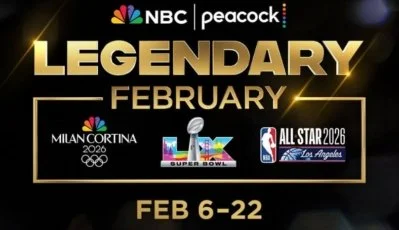
NBCUniversal kicked off 2026 with a sports trifecta: the Super Bowl, the Milan-Cortina Winter Olympics, and the NBA All-Star Weekend. The company dubbed it “Legendary February” and that’s what it turned out to be for the media company, its advertisers, and audiences.
While the Super Bowl didn’t break previous general-audience records, it broke Hispanic-viewership records in the U.S. and still managed to become the second-most watched TV program in U.S. history. The NBA All-Star game, showcasing a new format, saw increases over last year. And the Winter Games easily bested the previous Beijing games while the U.S. hockey teams delivered knock-out ratings.
250 unique marketers advertised across Super Bowl LX, the Milan-Cortina Winter Olympics and NBA All-Star Weekend
60% of those advertisers were new since 2022, the last time the network offered the Super Bowl and Winter Olympics
70% of advertisers across multiple events during the month
NBC represented 82% of all brand search engagements across broadcast networks during the Olympic time period.
On average, NBC delivered advertisers 4.5 times more search compared with ads on other broadcast networks combined during the same period
Olympics viewers who watched all three tentpole events were 53% more likely to engage with brands, driving greater attention for advertisers.
Advertisers across all verticals, from AI and Auto to Pharma and Insurance, were eager to tap into the engagement that fans bring to sports programming. NBCU reported the highest Olympic and Paralympic advertising revenue for Winter Games in company history. And while the Super Bowl wasn’t the most-viewed ever, it did manage the highest :30 second ad unit rate for Super Bowl ever and the highest total ad revenue in Super Bowl history, according to the company.
According to PJ Gasparini, SVP, Insights & Measurement, NBCUniversal Advertising & Partnerships, “the combined offering of the Milan Olympics and Super Bow LX drove Peacock to its biggest day ever, with platform consumption up +32% from its previous record (the day of the Peacock Wild Card Exclusive in January 2024).”
Gasparini told WPP Media that for brands participating in Legendary February, the “crossover didn’t just function as promotion but became a powerful platform for deeper brand storytelling.”
And the company provided plenty of support to make that storytelling powerful by providing data-enabled tools to help maximize performance of Super Bowl and Olympics ad creative. The Creative Ad Engine — a suite of proprietary tools that analyzes ad performance based on historical data — was available across both properties for marketers ahead of the games, enabling smarter creative decisions at scale. “That capability resonated with advertisers,” said Gasparini, “driving increased interest this year, with more creative tested and optimized across both environments, than the last Winter Olympics/Super Bowl.”
Olympics Ratings
The Milan Winter Olympics ended with an average 10.1 million P2+ viewers, up +9.1% compared to Beijing 2022. NBC non-prime saw double and triple-digit growth among all monitored demos, with overall viewership up 105.1%. Non-prime saw an average 4.3 million viewers, impressively up from both Beijing 2022 (2.2 million) and Pyeongchang 2018 (3.5 million).
USA Network and CNBC also experienced significant growth among all monitored demos with overall viewership up 55.6% and 75.5%, respectively.
The U.S. Men’s Hockey Gold Medal game closed out the 2026 Olympics with 18.6 million viewers for its live airing Sunday morning across NBC (14.86 million) and Peacock (3.7 million). Viewership peaked with 26 million viewers in overtime across NBC (20.86 million) and Peacock (5.1 million). This ranks as the third-most-watched hockey game ever in the U.S. behind just the 2010 Gold Medal game (27.6 million) and the 1980 USA/USSR “Miracle on Ice” game (34.2 million). Encore presentations of the game added 2.1 million.
NBCU reported that 5.3 million tuned in across linear & streaming as the U.S. Women’s Hockey team defeated Canada for their first Gold Medal since 2018. This ranks as the most-watched Women’s Hockey game of all time.
NBCU reported that the 2026 Winter Olympics averaged a total audience delivery of 23.5 million P2+ viewers, a figure that encompasses both primetime and “Milan Prime” (2-5p) across NBC, USA, CNBC, and Peacock/digital properties. Of this total, 10.1 million came via NBC primetime, up from the 2022 Winter games (9.3 million), but an equal share came via a combination of “Milan Prime” and cable prime.
Streaming of the 2026 Winter Olympics accumulated 16.7 billion viewing minutes on Peacock over the course of 17 days according to NBCU. This is, unsurprisingly, down from the 23.5 billion that the 2024 Summer games did but blows 2022 Winter out of the water (3.9 billion) and is more than double the sum of all previous Winter games (6.9 billion).
The post-Superbowl Olympic telecast was easily the most watched of the Milan Olympics, with 20.0 million P2+ viewers. The primetime airing of the Opening ceremony came in second with 13.3 million
NBCU reported that the 2026 Winter Olympics averaged a total audience delivery of 23.5 million P2+ viewers, a figure that encompasses both primetime and “Milan Prime” (2-5p) across NBC, USA, CNBC, and Peacock/digital properties.
Of this total, 10.1 million came via NBC primetime, up from the 2022 Winter games (9.3 million), but an equal share came via a combination of “Milan Prime” and cable prime.
NBCU also reported that Peacock delivered an average minute audience of 3.3 million viewers which are counted within that total. This is up significantly from the 2022 Winter streaming audience (516,000) and only off a bit from 2024 Summer (4.1 million).
Stars and Memes
In the U.S., the men’s and women’s hockey teams pulled in massive ratings, but if any one athlete became a household name it’s likely to be U.S. figure skater Alysa Liu, whose story of retirement and return to win gold captured the imagination of the nation. An incomplete listing of the Olympic stars include U.S. skier Mikaela Shiffrin, U.S. snowboarder Chloe Kim, Chinese freestyle skier (and U.S. citizen) Eileen Gu, U.S. speedskater Jordan Stolz, U.S. figure skater Ilia Malinin, and U.S. bobsledder Elana Meyers Taylor.
It’s interesting to note that it’s no longer a requirement win gold at the games to break through the narrative. In fact, while Malinin and Kim ultimately didn’t live up to the massive expectations put upon them, but that only seemed to make their stories more relatable.
And we’d be remiss not to mention Nazgul, a local dog who escaped onto the cross-country skiing track and won gold in the very competitive sport of Olympic memes.
Because social-media now plays such a big part in the games, NBCU didn’t leave that bit up to chance. The Milan Cortina Creator Collective brought in more than 25 creators to tell the stories of the Games through their eyes with on-the-ground access. And NBCU partnered with Meta, Overtime, Reddit, TikTok, and YouTube to aggregate content across every screen. (This was on top of dedicated NBC Olympic hubs on Apple TV, Amazon Fire TV, Cox, DIRECTV, DISH, Hulu, Prime Video, Samsung, Sling, Spectrum, Verizon, VIZIO, and YouTube TV.)
An EssenceMediacom Social Intelligence Team analysis of Brandwatch data found that the Games drove 11.8M mentions between Feb. 5 and Feb. 25, with conversation largely neutral but skewing negative (28.5% negative vs. 20.3% positive). On the positive side, social media cheered Team USA’s historic double hockey gold vs. Canada, standout performances from athletes, and, yes, Nazgul the wolfdog. The Opening Ceremony also drew strong engagement. What drove negativity: The loudest headwinds were geopolitics and activism (878K mentions; ~50% negative), with debates over Russian “neutral” athletes, Israel’s participation, protests over the event’s cost/environmental impact, and backlash to U.S. ICE presence in Milan. Political controversy surrounding the U.S. men’s hockey team also drove negative sentiment.
NBA All-Star Ratings
The 2026 NBA All-Star Game delivered 6.73 million P2+ viewers on NBC in its new USA vs the World format. All-Stars were divided into three squads competing via a round-robin tournament: Team USA Stars, Team USA Stripes, and Team World.
Sunday afternoon coverage of the 2026 Winter Olympics averaged 8.5 million viewers from 4-5 pm, providing a sizable lead-in for the All-Star Game. The Olympics, which has a much more female-skewing audience than NBA, had a noticeable impact on the composition of the All-Star Game audience with F2+ up +57.6% YOY and W18-49 up +10.1%.
The All-Star Celebrity Game on ESPN saw mainly declines among the monitored demos, with overall viewership falling 6.6% among total viewers.
The NBA Saturday Night Skills competition experienced mixed results with overall viewership growing 21.5% but P18-49 falling 19.9% YOY.
Much like NBC, the NBA leaned into social media. According to the NBA, the league invited more than 200 global creators to Los Angeles for the weekend. The creators were embedded across live broadcasts, in-arena programming, on-court competitions and fan experiences.
The Super Bowl
A Super Bowl with nothing but field goals through the end of the third quarter didn’t have enough kick to top last year’s numbers. For the first time since 2021, U.S. overall viewership for the big game declined.
But not by very much.
Even lacking the sort of offensive performances that audiences expect, Super Bowl LX between the Seattle Seahawks and the New England Patriots still did well enough to become the second-most watched TV program in U.S. history behind last year’s game.
The game delivered 121.63 million P2+ viewers in its main English-language broadcast across NBC, Peacock, and NFL digital properties, down 6.0% YOY from FOX’s broadcast of the matchup between the Kansas City Chiefs and Philadelphia Eagles (129.4 million in Nielsen’s Big Data panel).
Hispanic P2+ viewers were the lone monitored demo to deliver growth in the English-language broadcast, with 17.3 million tuning in (+4.5% YOY). The Spanish-language broadcast delivered 3.3 million viewers across Telemundo and Peacock, the best-ever viewership for a Super Bowl telecast in Spanish, eclipsing the previous record by 800,000.
Bad Bunny's Super Bowl half-time show averaged nearly 130 million viewers across NBC (123.76 million) and Telemundo (5.2 million), off a bit from Kendrick Lamar's half-time show last year, which did 138 million across FOX (135.02 million), Telemundo (2.08 million) and FOX Deportes (903,000). Meanwhile, Hispanics soared to 26.3 million across NBC (22 million) and Telemundo (4.3 million).
An estimated 26.55 million people streamed NBC’s coverage of Super Bowl LX across 12.6 million streams. The 12.6 million streams marks a decline from last year’s 14.6 million, with declines coming entirely from mobile and desktop devices, which accounted for just 1.33 million streams this year versus 3.81 million last year. The game saw approximately 11.2 million streams through a TV, up from 10.8 million last year.
Check out the complete WPP Media Super Bowl LX Post-Game Report here.