
CES 2026 POV: When AI Stops Being a Feature and Starts Running the Place
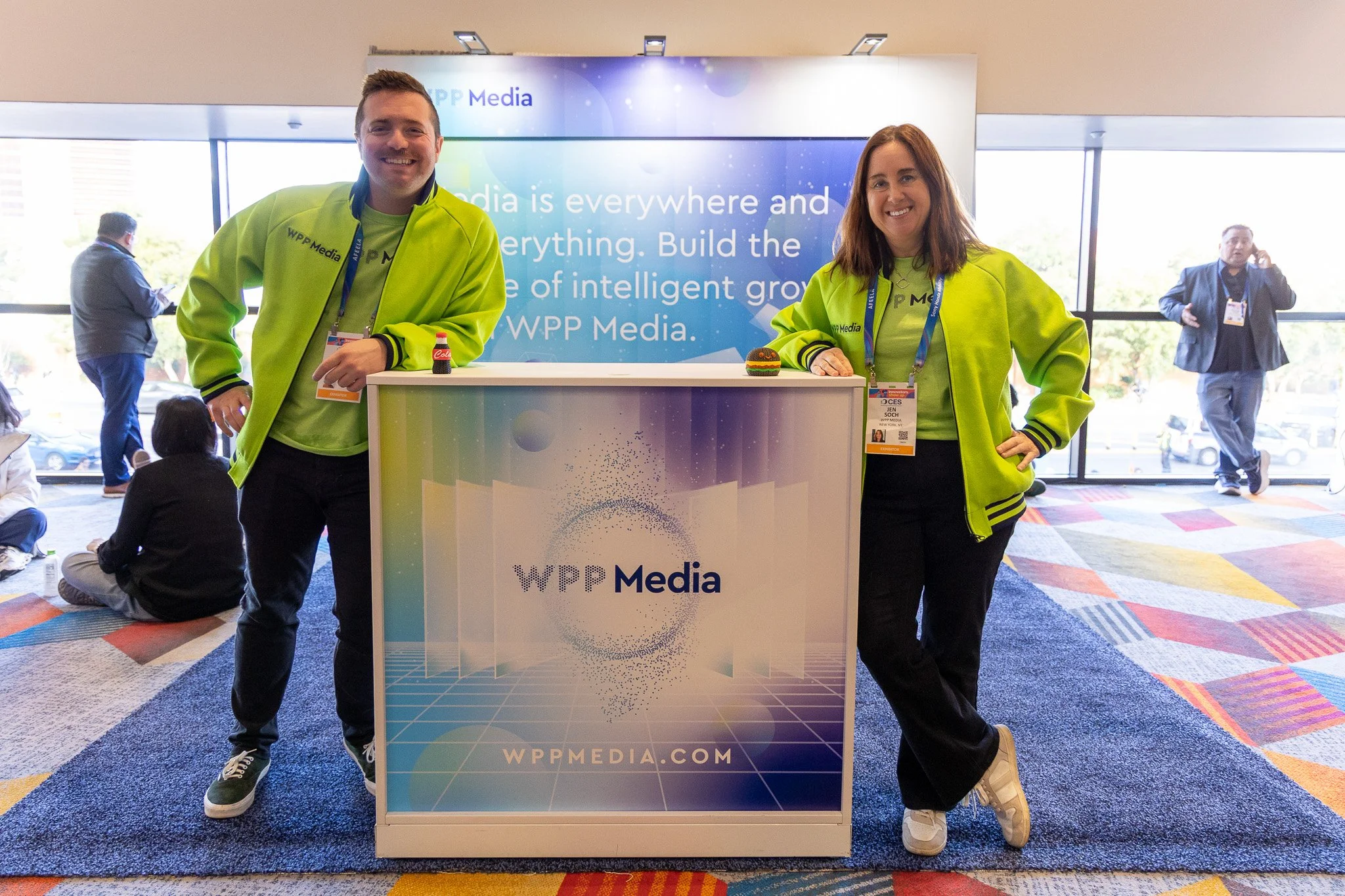
WPP Media’s Patrick Power (l.) and Jen Soch led tours at CES 2026.
Written by Patrick Power, Associate Director, Artificial Intelligence Solutions at WPP Media. Power led tours of the CES floors for clients during CES.
Executive Summary
CES this year was a loud, blinking sign that we’ve crossed a threshold: AI is leaving the app and becoming the operating layer of daily life. Not just user-directed actions or recommendations, but intelligent coordination between devices. Not just answering, but acting. Not just on screens, but in bodies, homes, cars, and increasingly, robots with hands.
Here are the five shifts that I believe mattered most:
AI orchestration is the product now. The value is no longer “smart device,” it’s the system that connects everything and anticipates needs.
Agents become gatekeepers. Brands soon compete inside recommendation systems and assistants, not just feeds and search results.
Embodied AI moves from novelty to workflow. Robots were everywhere, and the conversation shifted from “wow” to “workflow.”
Personal health becomes ambient and behavior-driven. The show floor leaned hard into sensing, coaching, and behavior change.
Media surfaces explode, but people demand consistency. TV, cars, XR, glasses, volumetric displays: Media is expanding into places that feel less like “media.”
The tradeoff threaded through all of it?
The same data that makes experiences feel magical also raises the trust bar.
When AI knows you deeply, it can help you deeply. It can also creep you out deeply. Brands will win by building trust and transparency with end users, with products/services designed for usefulness and restraint.
What It Felt Like on the Floor
The vibe was not “new gadgets.” It was closer to “everything that plugs in, rolls, or glows is getting a brain.” And those brains increasingly are able to talk to each other.
You could see it in the kitchen demos (AI-driven cooking assistants and grill automation), in home narratives (systems coordinating tasks and preferences), in digital health (more sensors, more bodily insights, more “signals”), in mobility (screens migrating onto windshields and dashboards), and in the sheer number of robots doing very human things: making coffee, serving ice cream, playing chess, reading to kids, folding laundry, and generally auditioning for the role of “helpful housemate.”
What really stood out is that we’ve moved from IoT (the Internet of Things that let you coordinate your smart devices through a bunch of apps) to what people are starting to call “AIoT” — an agentic layer that orchestrates across devices for you. Also, AIoT is a bad name. IoT was already a weird acronym and now we’ve basically made it “AI of Things,” which feels like we’re speedrunning our way into nonsense branding.
And the human part of it is this: Once these systems start remembering preferences and optimizing routines, it stops feeling like “using tech” and starts feeling like training a helper. In a weird way, it’s closer to teaching a pet than operating a machine: memory, routines, rewards, and the expectation that next time it’ll do better because it knows you.
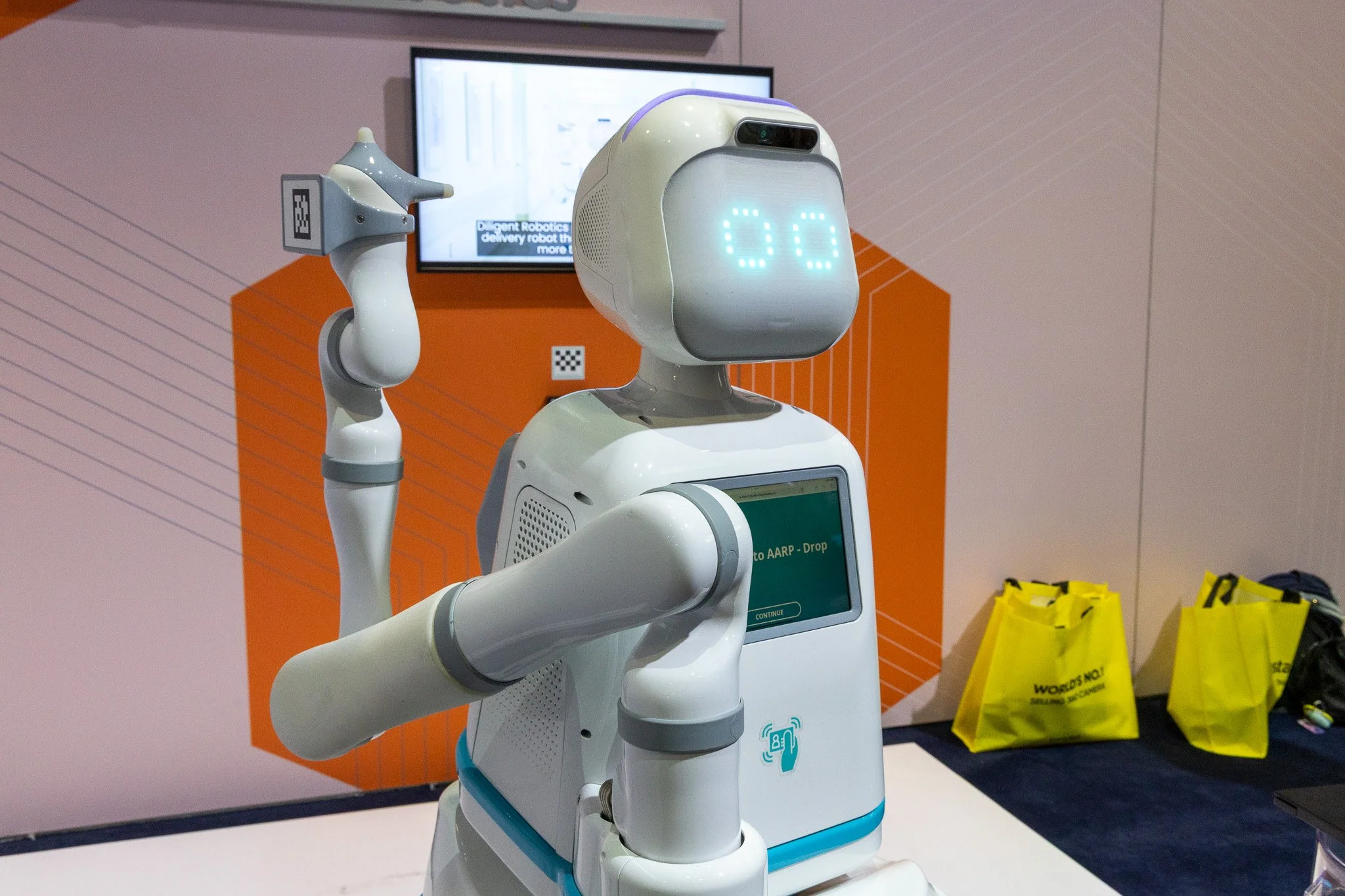
Diligent Robotics’ Moxi 2.0 at the AgeTech Collaborative from AARP accelerator program at CES 2026
The 5 Headline Shifts
Shift 1: AI Orchestration Is the Product Now
We’ve spent years calling things “smart home” and mostly meaning “a bunch of silo’d apps.” CES 2026 showed the next step: intent-driven homes where devices coordinate around outcomes.
In the kitchen, this looked like tools that don’t just execute commands, but help plan, adjust, and recover when real life happens. A cooking assistant that surfaces recipes, checks missing ingredients, and adapts cook time based on what you actually put in front of it is not just convenience. It’s orchestration.
With products like Brisk It, the story is even clearer: Use an agent to handle more of the end-to-end process, including planning what to eat and shopping, then hand off to automated cooking programs.
In the broader home narrative (and especially in big platform spaces like LG and TCL), the point is not a single device. The point is the system: coordinated screens, coordinated sensors, coordinated recommendations, and eventually coordinated commerce.
What changes for brands?
This is where brands stop competing only for attention and start competing for inclusion inside the system that’s making suggestions, automating routines, and deciding what shows up first.
You’ll increasingly win on being easy to orchestrate: fast setup, reliable integrations, sensible permissions, and “set-and-forget” automations that the system can run without breaking.
Orchestration expands markets by lowering the learning curve so casual hobbyists can participate (trying brisket or brewing beer without becoming an expert), which grows categories rather than replacing enthusiasts.
The practical play is an “entry to expert” ladder: effortless onboarding for beginners, plus optional depth and control for people who want to level up.
Orchestration runs on memory and context, so the brands and products that win will be the ones that make privacy and transparency feel like a feature, not fine print.
Shift 2: Agents Become Gatekeepers
The more assistants we add, the less the consumer is “searching.” The consumer is delegating.
That matters because delegation creates gatekeepers: assistants that decide what to show, what to suggest, what to reorder, what to ignore. We saw the early signals everywhere:
personalized recommendation layers in entertainment platforms
home systems that nudge you based on routines
food and health tools that guide choices based on goals and constraints
What changes for brands?
You’re not only marketing to a person anymore. You’re increasingly marketing to the agent layer that filters options, ranks recommendations, and sets defaults on behalf of that person.
“Being discoverable” starts to mean being machine-legible: clean product data, consistent naming, structured attributes, and clear proofs of value.
Brand differentiation shifts toward trusted signals that an agent can confidently act on (reliability, compatibility, return policies, safety, ratings, warranty, service).
The goal becomes winning the moments that matter: getting selected as the default, the reorder, the recommended bundle, or the “safe choice” when the system is uncertain.
This also changes creative: Messaging needs to be simpler, more precise, and more consistent across contexts so both humans and machines can interpret it without ambiguity.
When recommendations become automated, trust stops being a vibe and starts being a prerequisite for being chosen.
Shift 3: Embodied AI Moves From Novelty to Workflow
Robots were not a sideshow. They were a theme.
We saw robots in playful, consumer-friendly form (coffee art, ice cream, chess coaches), and we saw the more serious undertone: robots as labor augmentation. The show floor is full of home demos because they’re fun, but the near-term scaling path is likely in semi-structured environments: hotels, care facilities, retail operations, fulfillment, and anywhere you can standardize tasks and spaces.
Examples we bumped into across halls:
service-style bots like coffee and beverage automation (with touchscreens and customization)
robotic demonstrations emphasizing dexterity and sensing (the “can grab without crushing” message is a classic signal of maturing control systems)
companion-style products for kids that mix physical presence with camera-based interaction and parental dashboards
The “robot memory” angle is important here. As soon as a robot “remembers” preferences, you’re not buying a device anymore. You’re onboarding a relationship. That is powerful, and it comes with new questions: What does it store? Where? For how long? Who else can access it?
What changes for brands?
Brand experience becomes partly programmable: The quality of service depends on workflows, prompts, permissions, and guardrails as much as people.
If robots show up first in hospitality, care, and retail ops, brands should start planning for automation as a channel: guided assistance, in-store service, fulfillment, and support experiences that are delivered by a system.
“Memory” creates stickiness, but it also creates risk. Products that remember preferences will have to earn that right through clarity about what’s stored, where it lives, and how it can be deleted.
The winners will treat robotics like product design, not theater: Reliability, recovery when things fail, and safety will matter more than wow-factor.
As soon as a machine is moving around your space and “remembering” you, the bar for safety, privacy, and accountability jumps.
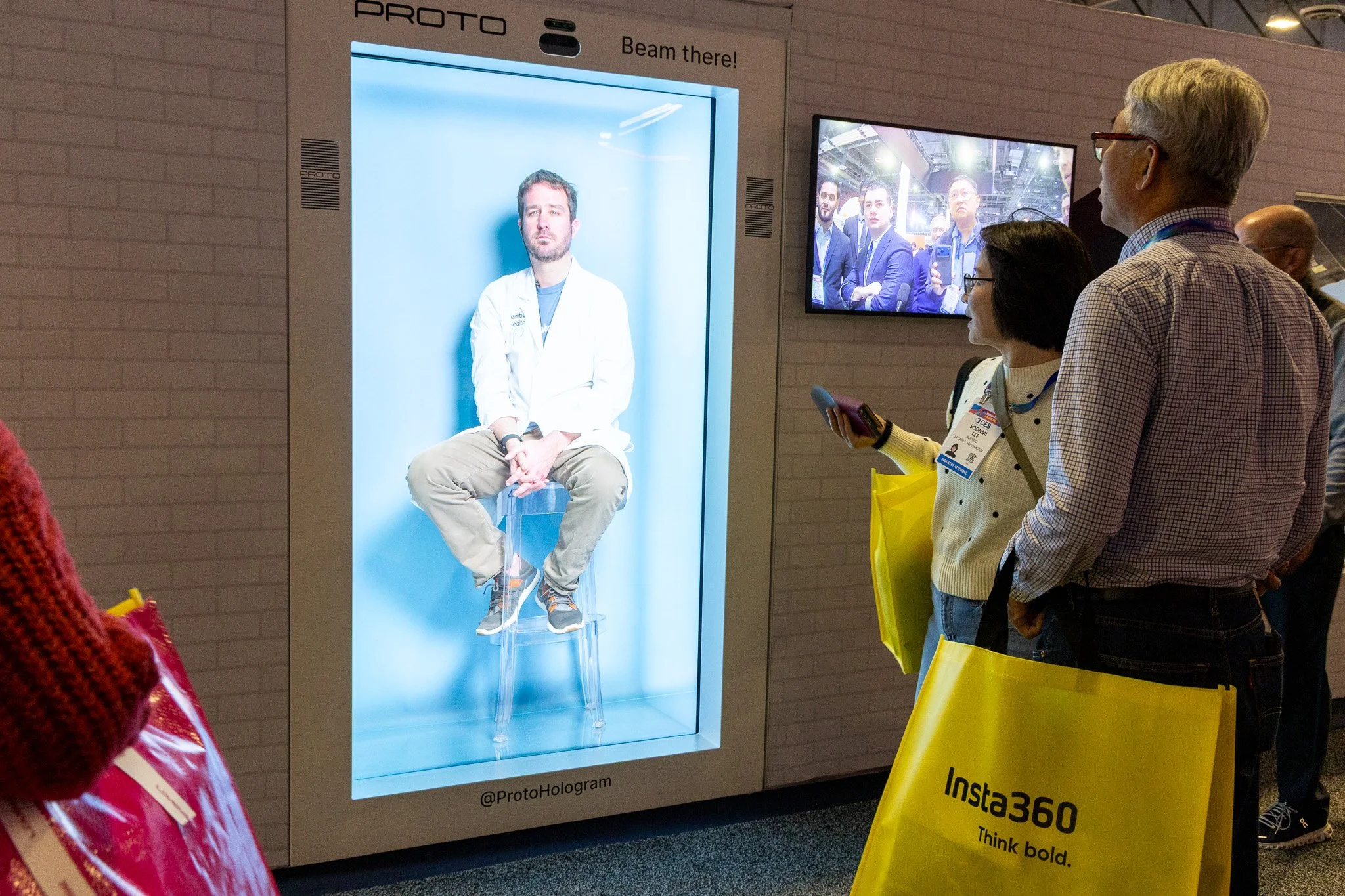
Proto Hologram demonstrates how holographic tech can connect healthcare professionals with patients in rural areas or in their homes
Shift 4: Personal Health Becomes Ambient and Behavior-Driven
Health tech is no longer confined to clinics or “fitness people.” CES made it feel like the next era is continuous measurement + coaching + personalization, increasingly tied to daily routines.
We saw this in multiple forms:
precision nutrition platforms that sync with wearables, support logging, and aim to help people manage conditions and lifestyle goals
senior living and aging-in-place support tools focused on safety, risk reduction, and caregiver coordination
a general “signals” mindset: capture more data, detect patterns earlier, intervene sooner
A parallel thread showed up in conversations around metabolism and GLP-1 culture: the market is moving toward behavior change systems, not just devices. Less “track your steps,” more “shape decisions.”
What changes for brands:
Personalization starts shifting from behavioral (“what you clicked”) to biological (“what your body is doing”), which expands the opportunity for a lot of categories, but also raises the standard for what’s appropriate.
The winning brands will treat health adjacency as an ecosystem play: tighter partnerships (wearables, platforms, healthcare systems where relevant), clearer guardrails on what data they use, and a strong point of view on what they won’t do.
Messaging has to evolve from inspiration to assistance: practical, routine-friendly guidance that fits into daily life, not vague wellness hype.
If you’re anywhere near health outcomes, you’ll need cleaner internal rules on claims, substantiation, and how personalization is explained, because the gap between “helpful” and “creepy” is thin and fast-moving.
Measurement gets more delicate: Assume less access to granular signals, plan for privacy-safe approaches, and prioritize experiments that prove lift without leaning on sensitive data.
When health data is even implied, people and regulators treat missteps as a trust-breaking event, not a minor PR issue.
Shift 5: Media Surfaces Explode, but People Demand Consistency
Media is expanding from “screens you choose” to surfaces you live inside. CES made it clear that TV, auto, XR, glasses, and even physical environments are all turning into programmable canvases for content, commerce, and brand experience.
TV keeps evolving into a home hub: bigger, thinner, more “art-like,” and increasingly layered with AI that optimizes the viewing experience and personalization.
Mobility is pulling media into the car in a more serious way, with dashboards and windshield-style concepts that turn driving into a context-rich content environment.
XR and gaming hardware is pushing immersion from visual to physical (haptics, motion, wearables), which changes what “engagement” even means.
Smart glasses are in a “let a thousand flowers bloom” phase, which usually means rapid experimentation now, consolidation later.
What changes for brands?
The opportunity isn’t just “more placements.” It’s more moments across more contexts, which forces brands to upgrade from campaign thinking to system thinking.
Creative needs to become modular and context-aware: same core idea, different execution depending on whether the moment is couch, car, headset, or out-of-home.
The win condition shifts from “reach” to “right time, right surface, right utility,” because these environments can be more situational and more interruptible.
Expect more pressure to connect storytelling to action: shoppable formats, assistive experiences, and interactive moments that don’t feel like ads stapled onto a screen.
Measurement gets harder as surfaces fragment, so teams need a tighter experimentation muscle (incrementality tests, controlled pilots) and fewer assumptions that every exposure will be trackable the same way.
Creator and fandom dynamics matter more here than people admit: New surfaces create new kinds of content, and brands that understand creator-native formats will travel farther across them.
When media shows up on your face, in your car, and in shared spaces, the line between “personalized” and “intrusive” gets thin fast, so consent cues and context sensitivity become part of good creative.
The Central Tension: “Know Me Deeply” vs. “Don’t Be Creepy”
Here’s the core tradeoff CES put on the table:
To orchestrate your life, AI needs context.
Context comes from data.
The new data sources live in the most sensitive places: homes, cars, bodies, and family spaces.
So the question becomes less “can we personalize” and more:
Should we?
How much is enough?
Who gets to decide?
What does consent look like in shared spaces?
This is where a lot of brands will stumble, not because they are evil, but because they are casual. Casual data practices will not survive ambient computing. If your product touches always-on sensors, you are effectively in the trust business.
The winners will build “usefulness with restraint.” That means:
Collect less by default.
Explain more clearly.
Let people opt out without punishment.
Treat privacy as a product feature, not a policy link.
The Strategic Pivot: The 2026 Marketing Architecture
The central lesson of CES 2026 is that the consumer's world is becoming Orchestrated, Agentic, and Signal-Driven. Yet, if we are honest, most marketing organizations are still built for 2015: siloed apps, manual search strategies, and cookie-based tracking.
You cannot run a seamless, AI-driven home experience if your media team and your creative team never talk. To navigate the shifts we saw on the floor, brands need to mirror the tech:
From "Apps" to an "Operating System"
At CES, a smart home doesn't work if the fridge can't talk to the oven. In marketing, a campaign doesn't work if your audience insights don't inform your creative production instantly.
The Fix: You cannot manage an orchestrated world with disconnected tools. You need a Marketing Operating System — what we call WPP Open — that connects the "Brain" (Strategy/Data) to the "Hands" (Creative/Production) in real-time. If an AI agent identifies an "impulse moment" (like a commuter playing a game), your system needs to instantly generate and serve the right creative asset. Silos are simply too slow for 2026.
From SEO to AIO, AEO, and GEO"
Being discoverable" used to mean ranking on Google. In an Agentic world (Shift No. 2), it means being "Machine-Legible" so an AI can read, understand, and recommend you. We are seeing the rise of a new optimization stack that brands must master:
AIO (AI Overview): Ensuring your content is structured so AI models can understand the context and summarize it effectively.
AEO (Answer Engine Optimization): Optimizing for direct answers so your brand is the "result," not just a blue link.
GEO (Generative Engine Optimization): Earning citations in generative AI results (like Perplexity or ChatGPT) by becoming a trusted data source.
The Fix: Brands need to audit their data hygiene now. If an assistant cannot understand your product data (ingredients, compatibility, specs), it cannot recommend you.
Intelligence Beyond ID
The "Central Tension" of CES was "Know me deeply vs. Don't be creepy." As media moves into intimate spaces — health sensors, home robots, car dashboards — the old way of tracking (cookies, IDs) feels invasive and is technically failing.
The Fix: We need to move to Signal-Based Intelligence. Instead of following a user's ID around the web, we use Open Intelligence to analyze anonymous signals — context, behavior, and "impulse moments" — to predict what a user wants without needing to know who they are. This is how you deliver personalization that feels like magic, not surveillance.
What I’m Watching Next
This is basically my own “so what happens now?” list:
Which connective tissue wins? Hardware-led ecosystems vs model-led ecosystems that sit across hardware.
Smart glasses: Proliferation occurs now, then consolidation, and a huge question around interoperability.
Robotics: Where will scale start first? (Hospitality and care feel closer than fully unstructured homes.
Health sensing: Which “signals” approaches survive scrutiny and become trusted standards?
Privacy: Whether “ambient regulation” catches up faster than companies expect.
Closing Thought
CES 2026 wasn’t just a collection of cool demos. It was a preview of a world where AI is ambient, systems are coordinated, and products increasingly “know” us. That can make life easier, healthier, and more personalized. It can also make life feel surveilled, manipulated, and brittle.
The opportunity for brands is not simply to adopt AI. It’s to adopt AI with taste. Use it where it genuinely helps people, design it so it earns trust, and build for a reality where the interface is no longer a screen you tap. It’s a system that acts.
If we get that right, the future is not “AI everywhere.” It’s good decisions, everywhere.